A village of weavers
At the start of the twentieth century, Yemmiganur, in the Kurnool district of Rayalaseema, was a village of weavers. Its people were skilled at the loom but had little means of selling their cloth beyond it. The master weaver Machani Somanna had five sons, and from 1915 three of them, Gangappa, Lakshmanna and Pakeerappa, carried the village’s handloom cloth to towns such as Mysore and Hassan. The weavers had the craft; the brothers gave it a market.
The 1930s were harder. Famine struck in 1934 and again in 1936, and it was the government, not the family, that ran relief centres for Yemmiganur’s famine-stricken weavers.
1938: the relief centres close
In 1938 the government closed its relief centres. The weavers still needed work, and Machani Somappa, the fourth of the brothers, answered by forming the Yemmiganur Weavers Cooperative Society.
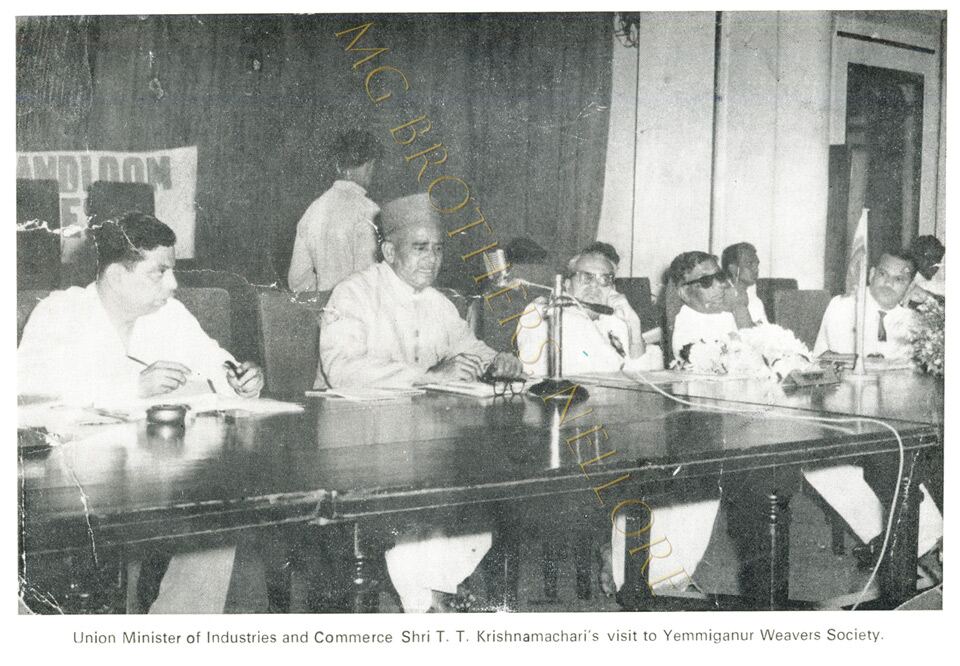
The society gave its members regular work at fair wages, and it did so steadily enough that, before long, other weavers from Yemmiganur and the villages around came to join. The society became the largest primary weavers’ cooperative in the country, and in time ministers and governors came to see it, among them T. T. Krishnamachari, the Union Minister of Industries and Commerce, and Bhimsen Sachar, Governor of Andhra Pradesh.
What grew from it
The cooperative changed more than the weavers’ wages. In 1940 Somappa set up Yemmiganur’s first spinning mill, which gave the village’s young people work of their own; the Machani Group counts that year as its beginning. The cooperative way then spread through the town: a store in 1942, a town bank in 1946, and in time societies for milk, housing, leather workers and marketing. In 1947 the foundation stone was laid for a Weavers Colony, with model houses and a children’s park, and in 1948, when a shortage of yarn threatened the looms, Somappa raised capital from the weavers themselves to start Rayalaseema Mills in Adoni.
The society’s success also took Somappa beyond Yemmiganur. In 1957 he became president of the All India Handloom Fabrics Marketing Co-operative Society, and led it as it became the country’s leading exporter of handloom.
Back to Yemmiganur
The family has kept returning to the town. In 2009, when Ravi Machani set out to bring work to rural India, IndiVillage was started in Yemmiganur, to give its women and young people jobs close to home. Seventy years apart, the cooperative and the company set out to do the same thing for the same town: give its people regular work.
Sources: MG Brothers, Heritage; Machani Group, Our history.