Most new trucks are assembled from catalogue parts. Tresa Motors takes the opposite approach: it designs the core of the vehicle itself, from the motors and drivetrain to the battery packs and the software that ties them together. Owning that stack lets its engineers tune each component for heavy-duty work, and change it far faster than a chain of suppliers would allow.
Flux 350, the motor
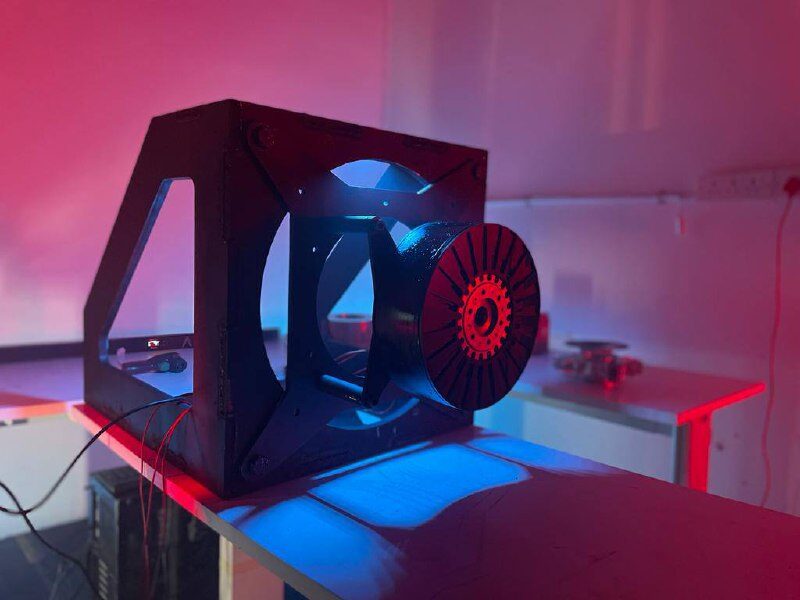
At the heart of every Tresa truck is Flux 350, a family of permanent-magnet synchronous motors designed and built in-house. In most electric motors the magnetic field runs outward from the shaft. In an axial flux motor it runs along the shaft, which gives a flat, disc-shaped machine: thin stators carrying the copper windings sit between rotors holding the magnets. The result is a short magnetic path, high torque for the weight, and short paths for heat, so the motor is easy to cool. Because each disc is slim, layers can be added or removed to change the output. Tresa says only a small number of companies in the world build motors this way.
Flux 350 is rated for a sustained 350 kW and is liquid-cooled, with coolant running right beside the windings so that it can hold its output on long climbs. Its stator uses cold-rolled grain-oriented steel, which cuts losses in the core. The current revision, RJ1, runs at about 92 per cent efficiency, and the team is looking for another three to four per cent. Tresa puts its cost well below that of imported motors of a similar rating, thanks to local sourcing and the simple, stackable design.
The e-axle
The motor sits in the axle. In 2023 Tresa showed its DAX-1 electric axle, which combines the Flux 350 motor, its controller, an automated manual gearbox and the differential in one unit. Putting all of that on the axle frees space in the chassis and removes losses along the driveline.
MEG50, the battery module
Tresa’s packs are built from its own MEG50 module: 50 kWh at 800 volts, sealed in an IP69 enclosure with its own active liquid cooling. Indian freight runs through every climate, from the salt flats of Kutch to Himalayan passes, so the cells are bathed in a fluid that carries heat away quickly and also suppresses fire, keeping a fault in one cell to that cell. The simple design means fewer parts for each kilowatt-hour. Modules let a truck carry the range its route needs: one is good for about 100 km in an 18-tonne truck, which takes up to six, while a 55-tonne tractor can take as many as fourteen.
Sensors and software
Tresa’s trucks carry LiDAR and camera arrays, and its own software, Performant AI, turns them into a live 3D picture of the road. That picture serves safety: spotting people, animals and debris early, by day or night, and guiding the truck as it reverses into bays and docks. It also serves efficiency. Each run adds speed breakers, potholes and gradients to a shared map, so the truck can plan its power and regenerative braking for the road ahead, and scanning the load bed helps crews fill a truck fully and evenly.
Sources: Tresa Motors, About Tresa, Flux 350, MEG50 battery module, Performant AI; Autocar Pro, Tresa Motors unveils e-axle with axial flux motor (September 2023).